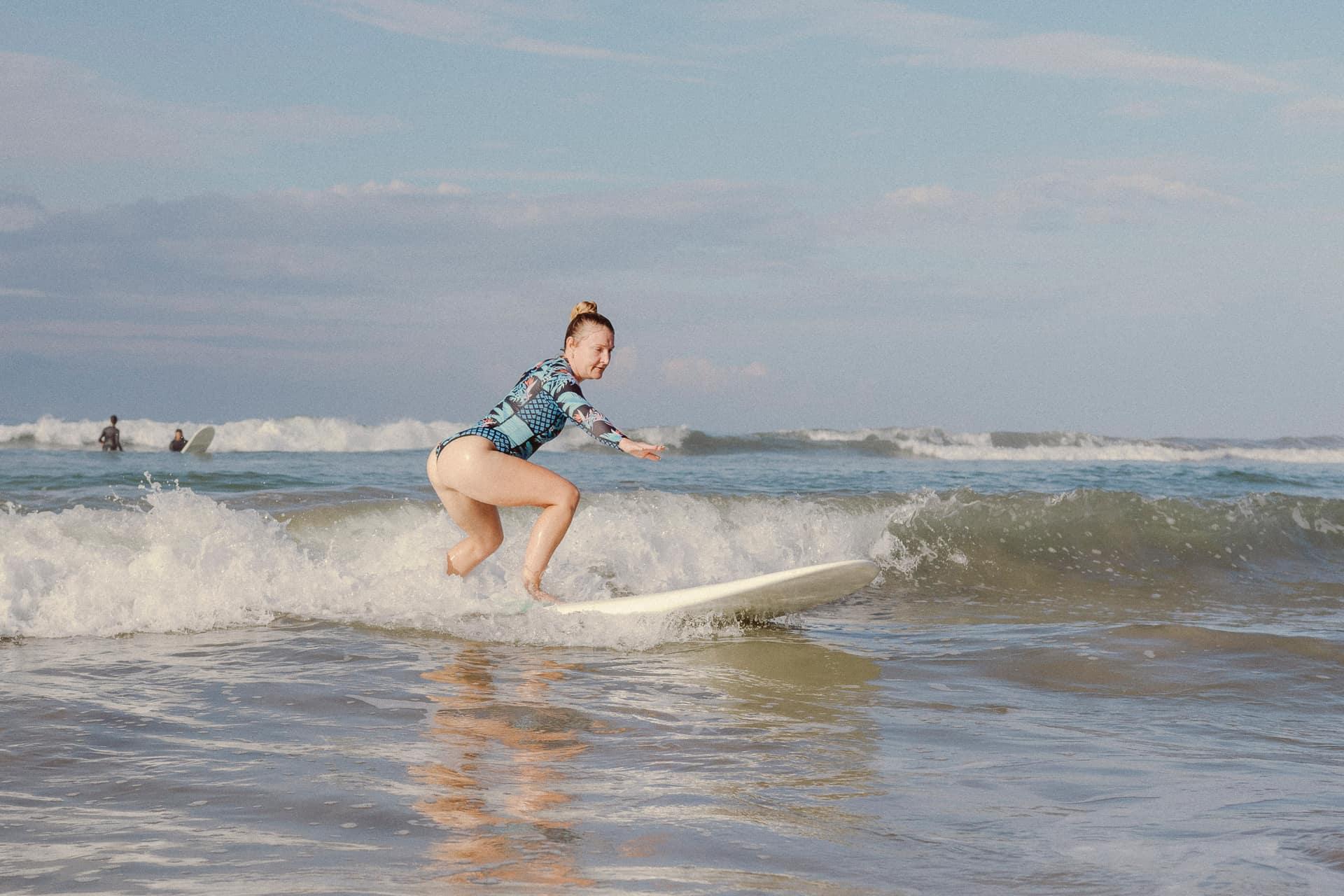
Standing up on a surfboard for the first time is one of the most exhilarating things a human body can do. It requires balance, timing, strength, and a willingness to fail repeatedly — and then suddenly it clicks, and the feeling is unlike anything else.
Santa Teresa, Costa Rica is one of the best places on the planet to learn to surf. Here is everything you need to know before your first lesson.
Why Santa Teresa Is Ideal for Beginners
Not every surf destination is beginner-friendly. Some spots have powerful shore breaks, dangerous rocks, or instructors who treat beginners as an afterthought. Santa Teresa works well for learners for several specific reasons:
Consistent, manageable waves. The beach breaks at Playa Carmen and the central section of Santa Teresa produce waves that are forgiving enough for first attempts but fun enough to keep you engaged as you improve. They are not tiny — but they are not the kind of heavy shore breaks that punish mistakes.
Warm water year-round. Water temperature sits around 27°C, which means you can focus entirely on your surfing rather than being distracted by cold. No wetsuit required (though a rash guard is recommended for sun protection).
Sandy bottom. Unlike reef breaks, Santa Teresa's main surf zones are over sand, which reduces the consequences of wipeouts significantly for beginners.
Experienced local instructors. The town has developed a strong surf coaching culture, with instructors who have been teaching for years and understand the specific challenges beginners face.
What Happens in a Beginner Surf Lesson
On the Beach (30–40 minutes)
Your lesson begins on dry land. This is not wasted time — the beach component is where the foundations are built:
- Ocean awareness: Your instructor reads the conditions with you. Where are the waves breaking? Where is the best paddling channel? Are there any rip currents to be aware of?
- Pop-up technique: You practice the fundamental movement — going from lying on the board to standing — repeatedly on the sand until the muscle memory begins to form. This is the most important skill in surfing and the one most beginners skip.
- Paddling mechanics: Efficient paddling means more waves caught. You will learn hand entry, stroke depth, and how to position your weight on the board.
- Safety briefing: How to fall safely, how to protect your head when coming up after a wipeout, and how to exit a rip current.
In the Water (60–90 minutes)
Now for the fun part. Your instructor will guide you to the right spot in the lineup and help you select waves based on your ability. In a good beginner lesson:
- The instructor reads waves and tells you when to start paddling
- You focus entirely on executing the pop-up you practiced on the beach
- Feedback is immediate and specific — not generic encouragement but actual adjustments
- You catch more waves than you would on your own
Expect to wipe out. A lot. This is not failure — it is the mechanism through which surfing is learned. Every wipeout teaches you something about wave reading, timing, or body position.
How to Prepare for Your First Lesson
Physical Preparation
You do not need to be a gym athlete, but some preparation helps:
- Swimming ability: You should be comfortable in open water. You do not need to be a strong swimmer, but you should not be afraid of the ocean.
- Core strength: Even gentle surfing uses the core constantly. A few weeks of plank variations and hip mobility work before your trip will make a noticeable difference.
- Shoulder flexibility: Paddling is repetitive and demands range of motion in the shoulders. Arm circles and doorway stretches are simple preparation.
Mental Preparation
The most important mindset for beginner surfing is this: your only goal is to stand up once. Not to look good. Not to go on every wave. Not to be as good as the person next to you. Stand up once and the lesson is a success.
Most beginners stand up on their first day. Not on every wave — but at least once. That moment is all you need to understand why surfing is worth learning.
What to Bring
- Reef-safe sunscreen applied 30 minutes before entering the water
- Rash guard or UV-protective shirt
- Board shorts or a swimsuit that stays on when wiping out
- Plenty of water — surfing is more physically demanding than it looks
- An empty stomach or a very light snack (wait at least 90 minutes after a full meal)
Common Beginner Mistakes (And How to Avoid Them)
Looking at your feet when standing up. Your eyes should be fixed on the horizon or the beach — where your gaze goes, your body follows. Looking down puts you off balance instantly.
Not paddling hard enough. The most common reason beginners miss waves is insufficient paddling speed. When your instructor says paddle, commit fully. Two extra strokes make the difference between catching the wave and watching it go by.
Standing up too early or too late. Timing the pop-up is a skill that comes with repetition. Too early and you miss the energy of the wave; too late and the nose digs. Your instructor will cue you — trust their timing until you develop your own instinct.
Stiff arms and locked knees. Surfing requires a relaxed body. Tension is the enemy of balance. Bend your knees, let your arms float, and breathe.
After Your First Lesson
If you catch the feeling — and most people do — here is what comes next:
- Day 2: You start to read waves yourself. Your pop-up gets faster and more automatic.
- Days 3–5: Consistency improves. You start to feel the difference between a good wave and a bad one.
- Week 2: Turning begins. You have a reference point for what your body needs to do.
Progression varies enormously between individuals, but in our experience at Zeneidas, guests who combine daily surf lessons with yoga show measurable improvement faster than those who only surf. The body awareness developed in yoga translates directly to balance and coordination on the board.
Santa Teresa is ready whenever you are. The waves are patient, the instructors are experienced, and the first stand-up is waiting for you.